Key facts
screening of
complex samples
Countless applications of HPTLC and planar bioassays
- Detection of toxins or hazardous compounds
- Detection of beneficial compounds
- Water and environmental screening for contaminants and pollutants
- Authenticity test and detection of adulteration
- Investigation of ingredients (e.g. UV protection, preservatives, dyes)
- Identification and detection of plant extracts or vitamins
- Quality control of products (e.g. fatty acids and lipids)
- Identify and qualify complex plant extracts
- Screening of drugs: identification of new active ingredients
- Quality control of ingredients to detect impurities
- Fast and easy on-site screening, for example of seized drugs or suspicious products
- Detection of counterfeit medicines
- Research into existing or new products
- Education in the areas above or the underlying separation and bioassay technology with fast visualization and results
HPTLC meets bioassay
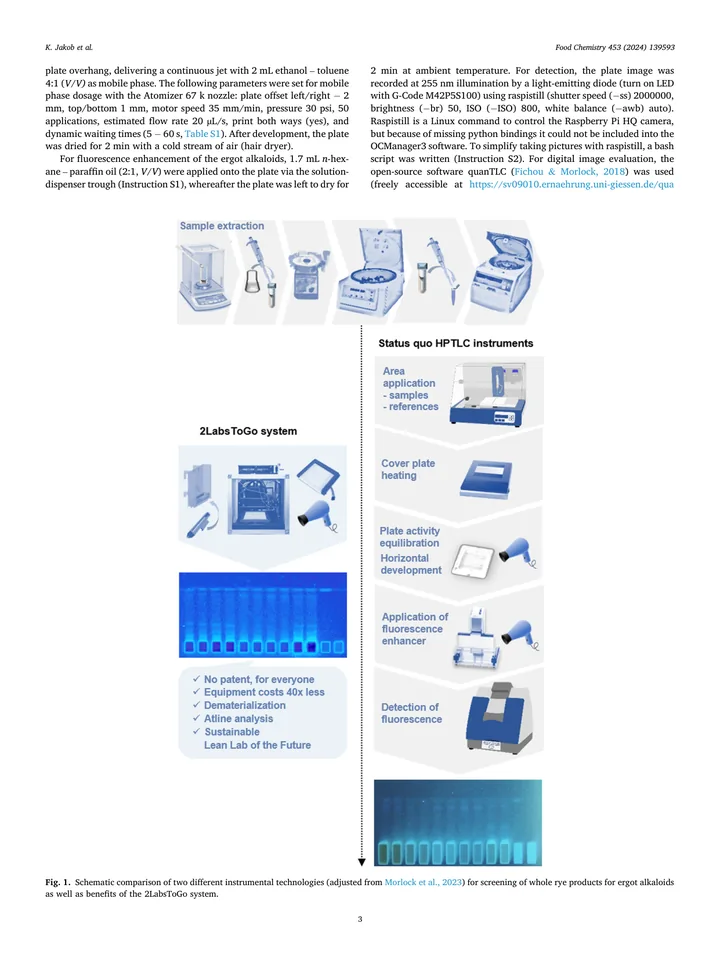
One system for the five steps of high-performance thin-layer chromatography (HPTLC) with effect-directed analysis: it separates each sample into its compounds, tests them for their biological effect on the same plate, and quantifies them against reference standards. Configured to your methods and your bioassays.
Each sample is sprayed onto the 10 × 10 cm HPTLC plate as a narrow band on the start line. The applicator builds a band from drops of about 10 nL; a typical band takes about 1 µL. Sharp, even bands are the basis for well-separated zones and reliable quantification later. chromnil one holds up to 9 samples in vials of 1–2 mL, in a rack for reusable glass vials or single-use plastic vials.
A solvent mixture, the mobile phase, separates each sample into its compounds. chromnil one doses it onto the plate itself, about 2 mL per plate. The solvent front moves across the plate by capillary action and carries the compounds along at different speeds, depending on their polarity. Each compound stops at its own height and the run ends once the front has traveled far enough.
The nebulizer lays a fine, even mist of the test system over the developed plate, for example luminescent bacteria, yeast cells or an enzyme, and the incubator keeps the plate at 30–37 °C for a set time. Zones with an effect stand out from the background, bright or dark depending on the assay; everything else stays invisible, so each effect is linked to the compound that causes it.
Many compounds are invisible on the plate. Once the bioassay has been imaged, the same nebulizer sprays a reagent over the plate; it reacts with the compounds into colored or fluorescent derivatives, and some reagents need the plate heated afterwards. Several reagents can follow one another, each imaged in turn. The choice of reagent depends on the compounds you are looking for.
The plate is imaged after development, after the bioassay and after each reagent: under UVA 365 nm, UVC 265 nm, visible light and white-light back illumination. The integrated 12 MP camera records the whole plate at once; each image is read track by track into densitograms, and the zones are identified and quantified against reference standards on the same plate. Images and densitograms are the data for interpretation and reporting.
Application
Each sample is sprayed onto the 10 × 10 cm HPTLC plate as a narrow band on the start line. The applicator builds a band from drops of about 10 nL; a typical band takes about 1 µL. Sharp, even bands are the basis for well-separated zones and reliable quantification later. chromnil one holds up to 9 samples in vials of 1–2 mL, in a rack for reusable glass vials or single-use plastic vials.
Where does chromnil fit?
chromnil shows which samples and which compounds have a biological effect, and quantifies them against reference standards on the same plate. It can be used alongside HPLC or GC, while mass spectrometry remains a compatible detector for identifying unknown compounds and confirming trace-level results.
Next to the methods you know
| Method | Best for | Where chromnil differs |
|---|---|---|
| Conventional HPTLC | Best for: Established HPTLC methods on 20 × 10 cm plates with a separate device for each step, full flexibility, pharmacopoeia work. | Where chromnil differs: chromnil connects the workflow, including the bioassay, in one system on a fraction of the bench space, with the same precision in the published comparison (4.1% against 4.8% RSD). |
| HPLC | Best for: Validated target methods, very complex mixtures and long unattended series. | Where chromnil differs: chromnil shows the biological effect of separated zones and screens many samples side by side on one plate. |
| GC | Best for: Volatile compounds and established gas-phase separation methods. | Where chromnil differs: chromnil works with non-volatile compounds and reveals biological effects; MS can be coupled when compound identification is needed. |
| Microplate bioassay | Best for: Testing the effect of whole samples in high throughput. | Where chromnil differs: chromnil separates the mixture first, helping locate the compound responsible for an effect. |
| ELISA / lateral flow | Best for: Fast tests for one known target, also on site. | Where chromnil differs: chromnil can reveal effects from compounds nobody was looking for, not only one predefined target. |
All criteria in detail
| chromnil | HPTLCConventional HPTLC | HPLC | GC | MicroplateMicroplate bioassay | ELISA / LFAELISA / lateral flow | |
|---|---|---|---|---|---|---|
| yes | yes | no | no | yes | no | |
Whether the method reveals what a compound does, e.g. antibacterial or hormone-like activity. chromnil: Bioassay directly on the plate: antibacterial, genotoxic, enzyme-inhibiting, hormone-like or cytotoxic zones become visible; chemical assays such as radical scavenging run the same way. Conventional HPTLC: The same planar bioassays, with a second laboratory of devices: derivatizer, incubator, bioluminescence imager. HPLC: Reports a UV/DAD signal. Biological activity needs a separate test. GC: Reports signals from volatile compounds, not their effect. GC-MS adds identification, not biological activity. Microplate bioassay: Measures the effect, but of the whole mixture in each well. ELISA / lateral flow: Measures binding to one antibody, not a biological effect. |
||||||
| yes | yes | no | no | no | no | |
Whether you can tell which compound in a mixture causes the effect, even one nobody was looking for. chromnil: Compounds are separated before the bioassay, so an active zone shows where its compound sits, without a reference standard. Where compounds overlap, one zone can hold more than one. Conventional HPTLC: The same principle: separation first, then the bioassay on the plate. HPLC: Only with extra steps, by collecting fractions and testing each one separately. GC: No effect measured. Activity needs a separate workflow. Microplate bioassay: Effects of all compounds add up in one well; the active compound stays unknown. ELISA / lateral flow: Any compound binding the antibody gives a signal, including cross-reacting ones. |
||||||
| yes | yes | no | no | yes | yes | |
How many samples are processed at the same time. chromnil: Up to 9 samples plus standards side by side on one plate, under identical conditions. Conventional HPTLC: Up to about 15 tracks on a 20 × 10 cm plate. HPLC: One injection after another; an autosampler runs long series unattended. GC: One injection after another; an autosampler runs long series unattended. Microplate bioassay: 96 wells per plate. ELISA / lateral flow: Many wells or strips at once. |
||||||
| yes | yes | partly | partly | partly | partly | |
How much clean-up a sample needs before analysis. chromnil: Minimal. Each plate is used once, so the matrix stays on it and does not harm the system. Conventional HPTLC: Minimal, as on any HPTLC plate. HPLC: Clean-up and filtration to protect the column. GC: Clean-up, often derivatization for less volatile compounds. Microplate bioassay: Matrix and solvents can interfere with cells or enzymes. ELISA / lateral flow: Often just dilution, but matrix interference and cross-reactivity have to be controlled. |
||||||
| yes | yes | no | partly | yes | yes | |
Solvent and gas consumed per analysis. chromnil: About 2 mL of mobile phase per plate, shared by all samples on it, plus about 1.5 mL of rinsing solvent per sample. Conventional HPTLC: Milliliters per plate, more with a saturated twin-trough chamber. HPLC: Continuous solvent flow for every run, typically tens of milliliters per sample; less with UHPLC. GC: Little solvent, but carrier gas, often helium. Microplate bioassay: Low. ELISA / lateral flow: Very low. |
||||||
| partly | partly | partly | partly | no | partly | |
Whether the method tells you what a compound is. chromnil: Against reference standards on the same plate, by position and color. An unknown active zone needs mass spectrometry to be identified. Conventional HPTLC: Against reference standards; unknown zones go to mass spectrometry through an elution interface. HPLC: Retention time and UV spectrum against reference standards. GC: Retention time and detector response; GC-MS can identify compounds against spectral libraries. Microplate bioassay: Does not identify compounds. ELISA / lateral flow: Recognizes only the one target the antibody was made for. |
||||||
| partly | partly | yes | yes | no | no | |
How many similar compounds the method can tell apart in one sample. chromnil: A plate resolves fewer compounds than a column. Enough for screening, less so for many similar compounds. Conventional HPTLC: A plate resolves fewer compounds than a column; the same limit as chromnil's. HPLC: A column resolves many more peaks than a plate. GC: High resolution for volatile compounds. Microplate bioassay: No separation. ELISA / lateral flow: No separation; selectivity comes from the antibody. |
||||||
| partly | partly | partly | partly | partly | yes | |
Whether the method reaches the very low limits some residues and contaminants require. chromnil: Nanogram amounts per zone for many compounds, picograms in sensitive bioassays. Trace residues need mass spectrometry. Conventional HPTLC: Nanogram amounts per zone, picograms in sensitive bioassays; the same as chromnil's. HPLC: Depends on the detector; UV is less sensitive than MS. GC: Depends on the detector; GC-MS can reach trace levels for volatile compounds. Microplate bioassay: Depends on the assay. ELISA / lateral flow: Very sensitive, for its one target. |
||||||
Built on 15 years of open research
chromnil one is developed from the 2LabsToGo-Eco, an open-source instrument for HPTLC with planar bioassays from Prof. Gertrud Morlock's group at Justus Liebig University Giessen. Since 2022 it has been validated against commercial HPTLC instruments in peer-reviewed studies, with results on par, most recently also with planar bioassays on the plate, and its hardware, firmware and software are published under open licenses.
At chromnil we turn this research into an instrument for routine laboratory work. An academic instrument is one you build yourself, from ordering the parts to calibration and repairs, and most laboratories have neither the staff nor the engineering skills for that. chromnil one builds on the 2LabsToGo-Eco with hardware and software of our own that make it more robust and easier to use. Every system arrives assembled, calibrated and configured, with software updates, service, training and support.
How chromnil works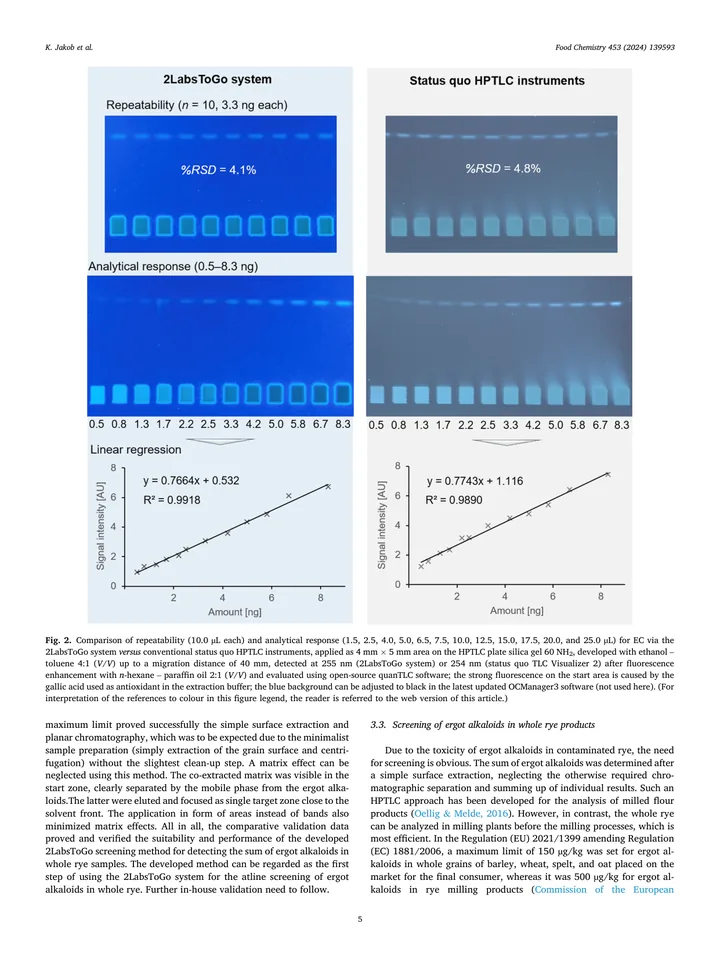
What you get with the chromnil one HPTLC instrument
The instrument
Intuitive and user-centered
A single program runs the whole workflow, from application to the plate image, and guides you through the steps of your method, so fewer things can go wrong between devices. It runs on a connected computer and needs no internet connection.
Quantitative assessment
Automated application, development and imaging give repeatable results. The open-source system behind chromnil one reached 4.1% RSD and R² 0.9918 in a peer-reviewed comparison with status quo HPTLC instruments (4.8% and 0.9890).
Time-saving
Up to 9 samples run side by side on one plate, under identical conditions, and the automated steps need little hands-on time. The bioassay and the reagents are applied by the connected nebulizer, controlled from the same software.
Sustainable
HPTLC needs little sample preparation and about 2 mL of solvent per plate, shared by all samples on it. In the published comparison, the open-source system behind chromnil one needed a twelfth of the weight, a ninth of the bench space and a quarter of the energy of the commercial devices it replaces.
The service
Ready to use
We provide the assembled system, configured to your needs
Automated updates
The software will get updated regularly to ensure optimal performance
Service
We offer fast and reliable system service if the system malfunctions or gets damaged
Support
Training and continuous support help you operate the system as efficiently as possible